Herstellung medizinischer Cannabisextrakte in der Apotheke

Noch greifen die meisten Cannabispatienten auf das Verdampfen und Inhalieren getrockneter Blüten zurück. Dies hat Nachteile, wie die begrenzte Wirkstoffaufnahme in den Blutkreislauf. Die Inhalation ermöglicht zwar eine rasche Aufnahme von THC, was für die Schmerzbehandlung von Vorteil ist, aber bei der Verbrennung durch das Rauchen werden Wirkstoffe zerstört und es entstehen giftige Beiprodukte. Das Inhalieren kann die Atemwege reizen und bietet eine vergleichsweise kurze Wirkdauer von ca. zwei Stunden. Eine schonendere Darreichungsform mit einer gleichmäßigeren und längeren Wirkdauer von bis zu sechs Stunden sind Extrakte und Kapseln. Laut der pharmazeutischen Empfehlung sind diese in der Therapie vorzuziehen. Sie kommen traditionellen Medikamenten näher als getrocknete Blüten, die oft mit dem Freizeitkonsum in Verbindung gebracht werden. Patienten benötigen außerdem keine Hilfsmittel wie Feinwaagen und Vaporisatoren. Mithilfe von Sprühaufsätzen, Kolbendosierpipetten mit ml-Anzeige oder Kapseln können sie die Extrakte leichter dosieren und diskreter einnehmen, da kein Dampf entsteht.

Vorbereitung für die kryogene Ethanol-Extraktion

Ein Blick ins Labor der Grünhorn Apotheke in Leipzig: Mehrere große Glaskolben drehen sich über Stunden und bewegen eine zähe, fast schwarze Substanz ‒ reinstes Cannabisextrakt. Im forschenden und herstellenden Labor fertigen Pharmazeuten Extrakte aus Cannabisblüten der Grünhorn Eigenmarke an. Wöchentlich wird rund ein Kilo Kultivare wie „El Jefe”, „Bedrocan”, „Gorilla Glue“ und „Scotti’s Cake“ der Genetiken Sativa, Indica und Hybrid extrahiert. Laborleiter und Apotheker Benjamin Wende prüft die Identität der Blüten mit einem Nahinfrarot-Spektrometer (NIR) und testet sie chargenweise mit dem Gaschromatographie-Massenspektrometer auf den Terpengehalt. Wie eine kürzlich veröffentlichte Studie der Grünhorn Apotheke zeigt, spielen Terpene bei der therapiegerechten Sortenauswahl eine zentrale Rolle neben den Cannabinoiden und der Genetik. Zusätzlich erfolgt eine pharmazeutische Prüfung der Analysenzertifikate mit dem Fokus auf mikrobielle Verunreinigungen wie Schimmel oder erhöhte Keimzahlen.

Im nächsten Schritt zerkleinern Mitarbeiter die Blüten und bereiten sie für die Ethanol-Extraktion vor. Das Lösungsmittel muss dazu heruntergekühlt werden. Die kryogene Ethanol-Extraktion erlaubt es durch Temperaturen zwischen ‒ 30 und ‒ 60 Grad Celsius, Verbindungen wie Chlorophyll, die sich normalerweise gut in Wasser lösen, durch die Kälte zu inhibieren (hemmen). Auf diese Weise können die erwünschten Wirkstoffe extrahiert werden, ohne dass Bestandteile gelöst werden, die dem Extrakt einen erdigen, scharfen und bitteren Geschmack verleihen und keinen nachweisbaren therapeutischen Nutzen haben. Erwünschte Bestandteile wie Terpene und die Cannabinoide THC und CBD werden dagegen aus den Pflanzenzellen gelöst. Ein Vorteil des Verfahrens liegt darin, dass Restwasser sowie unerwünschte Fette und Wachse in gefrorenem Zustand vorliegen und im anschließenden Filtrationsschritt zusammen mit dem Pflanzenmaterial entfernt werden können, ohne in das Filtrat zu gelangen. Das macht die zeitaufwendige Winterisierung überflüssig, die üblicherweise eine Ruhezeit von 24 Stunden erfordert.

Extraktion und Filtration

Nachdem das Ethanol zur Extraktion in einem mit Kühlmittel ummantelten doppelwandigen Reaktor auf Temperaturen zwischen ‒ 30 und ‒ 60 Grad Celsius heruntergekühlt wurde, gibt der Apotheker die zerkleinerten Cannabisblüten hinzu. Es folgt die „Benetzungsphase”, in der das Cannabis-Ethanol-Gemisch für eine bestimmte Zeit gerührt wird, bis alle Blütenteile mit dem Extraktionsmittel in Kontakt gekommen sind. Danach schalten die Mitarbeiter unter Rühren Ultraschall hinzu. Die Kombination von Ultraschall und Kryoextraktion steigert die Effizienz des Verfahrens zusätzlich. Anschließend wird das Cannabis-Ethanol-Gemisch filtriert und durch Abtrennung des Pflanzenmaterials vom Cannabis-Ethanol-Gemisch eine Lösung hergestellt, die Cannabinoide, Terpene und andere lösliche Verbindungen der Cannabispflanze enthält.

Gewinnung und Standardisierung des Cannabisrohextrakts

Um das Ethanol von der Lösung zu trennen, wird es im Rotationsverdampfer entfernt. So entsteht ein dickes, harzartiges Cannabisrohextrakt, das allerdings noch keine bzw. sehr geringe Anteile an aktivierten Formen der Cannabinoide enthält und daher im Folgeschritt decarboxyliert werden muss. Dabei wird die enthaltene Carbonsäuregruppe des THCA durch das Einwirken von Hitze und unter Freisetzung von CO2 abgespalten und so in die psychoaktive Form Δ9-THC umgewandelt. Die Hitze während der Decarboxylierung birgt das Risiko, dass nicht nur die Carbonsäurefunktion zersetzt wird, sondern auch die flüchtigen Terpene beeinträchtigt werden und neue Verbindungen wie hochreaktive Aldehyde und Ester entstehen. Daher muss die Temperatur sorgfältig kontrolliert und der Prozess zeitlich begrenzt werden, um die gewünschten Cannabinoide zu aktivieren, ohne wertvolle Terpene zu zerstören.

Um zu gewährleisten, dass das finale Extrakt tatsächlich auf die Zielkonzentration der Cannabinoide Δ9-THC und/oder CBD eingestellt ist, muss der Cannabisrohextrakt zunächst mittels Flüssigchromatographie auf seine Cannabinoidgehalte untersucht werden. Hierfür kommt die hauseigene HPLC (High Performance Liquid Chromatography) zum Einsatz. Aus dem quantitativ untersuchten, hochkonzentrierten Ausgangsstoff mischen die pharmazeutischen Mitarbeiter im nächsten Schritt patientenindividuelle Extrakte oder Standardextrakte mit Trägerölen wie MCT-Öl.

Qualitätsprüfung und Überführung in Primärpackmittel

Um sicherzustellen, dass das standardisierte Extrakt alle pharmazeutischen Qualitätskriterien erfüllt, werden vor der Abgabe an die Patienten Freigabetests durchgeführt. Das fertige Extrakt wird erneut mittels HPLC auf den finalen Wirkstoffgehalt und den Cannabinol-Anteil überprüft, der unter 2,5 Prozent liegen muss. Zusätzlich wird via Trocknungsverlust geprüft, ob das Lösungsmittel Ethanol ausreichend entfernt wurde, da davon nicht mehr als 0,5 Prozent im Extrakt enthalten sein dürfen. Diese Grenze gilt auch für den Wassergehalt, der mit dem hauseigenen Karl-Fischer-Titrator bestimmt wird, um zu gewährleisten, dass im Produkt kein mikrobielles Wachstum stattfinden kann. Sind all diese Kriterien erfüllt, erfolgt die Abfüllung, Verpackung und der Versand an die Patienten.

Beachten Sie | Das am häufigsten verwendete Cannabisextrakt hat ein ausgewogenes Verhältnis von THC zu CBD von 10 : 10 oder 25 : 25. Auch reine THC-Extrakte mit 25 oder 50 mg/ml THC werden häufig verschrieben. Je nach Anwendungsgebiet in der Schmerztherapie oder Palliativmedizin sind höhere Konzentrationen möglich.

Weitere gängige Extraktionsmethoden

Neben der beschriebenen Ethanol-Extraktion, die sich als kostengünstige und effiziente Methode etabliert hat, gibt es verschiedene andere gängige Methoden. So eignen sich auch Lösungsmittel wie Isopropanol oder Hexan dazu, Cannabinoide und Terpene aus der Pflanze zu extrahieren. Diese Methoden sind effizient, es besteht jedoch die Gefahr von Lösungsmittelrückständen, die die Qualität des Endprodukts beeinträchtigen. Weitere Methoden sind:

  • Bei der Butan-Extraktion wird Butan als Lösungsmittel verwendet. Die Methode ist kostengünstig und beliebt für die Herstellung von Cannabiskonzentraten wie „Shatter“ oder „Wax“, die jedoch eher für den Freizeitkonsum als für pharmazeutische Zwecke verwendet werden. Um ein reines Endprodukt zu erhalten, muss das Butan vollständig verdampft werden, da es hochentzündlich ist.
  • Die CO2-Extraktion nutzt Kohlendioxid unter hohem Druck und niedriger Temperatur, um Cannabinoide und Terpene aus der Pflanze zu extrahieren. Dabei wird CO2 in seinen superkritischen Zustand gebracht, in dem es sowohl die Eigenschaften einer Flüssigkeit als auch die eines Gases besitzt. Die CO2-Extraktion ist sehr präzise und erlaubt die Gewinnung eines reinen Extrakts ohne Rückstände von Lösungsmitteln. Der Nachteil dieser Methode ist, dass sie in einer Apotheke schwer apparativ umzusetzen ist und einen enormen sicherheitstechnischen Aufwand erfordert.
  • Bei der Trockeneis-Extraktion werden Cannabisblüten mit Trockeneis in einem Sieb geschüttelt. Durch die extreme Kälte lösen sich die Trichome, also feinste Härchen auf der Blüte, die Cannabinoide und Terpene enthalten. Sie setzen sich als Harz am Boden des Siebs ab. Diese Methode ist einfach und kann ohne den Einsatz von Chemikalien durchgeführt werden.
  • Die Rosin-Extraktion funktioniert ohne Lösungsmittel durch Hitze und Druck, indem Cannabisblüten zwischen heißen Platten gepresst werden, bis Harz austritt. Diese Methode bietet aber nur einen geringen Ertrag.
  • Die Ultraschall-Extraktion ist eine aufstrebende Methode. Bei dieser Technik werden hochfrequente Ultraschallwellen genutzt, um die Zellstrukturen der Pflanze zu zerstören und die Cannabinoide und Terpene freizusetzen. Die Schallwellen erzeugen Kavitationsblasen, die implodieren und starke mechanische Kräfte freisetzen, wodurch die Zellwände der Pflanze aufgebrochen werden und die Wirkstoffe in ein Lösungsmittel wie Ethanol übergehen. Das Lösungsmittel erwärmt sich, was ein Sicherheitsrisiko darstellt.

Verbreitung von Extrakten weiter stärken

Das Forschungslabor der Grünhorn Apotheke arbeitet stetig an neuen Wegen, um Cannabisextrakte weiter zu verbessern. Effizientere Verfahren ermöglichen durch eine Skalierung die Senkung der Produktionskosten. Dies könnte zu einem niederschwelligeren Zugang zu den bisher sehr teuren Cannabisextrakten führen. Ein Vergleich: Während eine 25-ml-Flasche Cannabisextrakt im Verhältnis 25 : 1 von THC zu CBD im Jahr 2021 noch durchschnittlich 410 Euro kostete, sind es heute dank optimierter Extraktionsmethoden teilweise unter 150 Euro. Auch der Geschmack kann durch innovative Methoden verbessert werden. Wassermangel, UV-Strahlung und mechanischer oder pathogener Stress führen dazu, dass die Cannabispflanze Abwehrstoffe freisetzt, um Fressfeinde durch einen unangenehmen Geschmack abzuwehren.

Lange Zeit enthielten Extrakte kaum Terpenbestandteile. Hersteller könnten zukünftig zunächst die flüchtigen Terpene extrahieren, dann erst zur THC- und CBD-Extraktion übergehen und die Terpene zum Schluss wieder beifügen, um eine noch höhere Ausbeute an Wirkstoffen bei neutralerem Geschmack zu erreichen. Auch die Nanotechnologie könnte eine Rolle bei der Verbesserung der Extrakte spielen. Kleinere Partikelgrößen ermöglichen eine schnellere und effektivere Aufnahme der Cannabinoide im Körper und können so einen weiteren entscheidenden Nachteil von Extrakten ausgleichen: die langsamere Wirkstoffaufnahme im Vergleich zur Inhalation.

Weiterführende Hinweise

  • Studie der Grünhorn Apotheke: N. Herwig, S. Utgenannt, F. Nickl, P. Möbius, L. Nowak, O. Schulz, M. Fischer: Classification of Cannabis Strains Based on their Chemical Fingerprint ‒ A Broad Analysis of Chemovars in the German Market: www.iww.de/s11948
  • G-BA: „G-BA regelt Verordnung von medizinischem Cannabis bei schweren Erkrankungen: Keine zusätzlichen Anforderungen, die über die gesetzlich zwingenden und für den G-BA verbindlichen Verordnungsvoraussetzungen hinausgehen“: www.iww.de/s11949
  • Kostenvergleich cannabishaltiger Arzneimittel: www.iww.de/s12016
  • Processing and extraction methods of medicinal cannabis: a narrative review, PMC: www.iww.de/s11950

Quelle: Apotheke Heute Ausgabe 02 / 2025 | Seite 7 | ID 50234685

von Dr. Stephan Utgenannt und Maja Hoock, Leipzig

Competing in winter sports with one leg and a prosthetic

The Paralympic Winter Games are being held in China from 4 to 13 March, 2022, with around 700 athletes vying for gold in Beijing, Yanqing and Zhangjiakou. These winter athletes with disabilities rely on technical devices such as skiing and snowboarding prostheses to put in their very best performances.

For an athlete with a leg amputation, gliding smoothly down a black run might appear impossible at first – but for Kaiyang Liu from China, it has become a reality. The young man is one of around 700 athletes who are competing in various disciplines such as Para Ice Hockey, Alpine Skiing, Biathlon and Snowboarding at the 2022 Paralympic Winter Games in Beijing.

A Para snowboarder, Kaiyang Liu had an amputation when he was five years old due to a severe car accident. He is now achieving one of his life’s goals by representing China, his native country, at the Paralympics: “This is a one-time chance for each of the athletes that comes after many years of hard training. I am very grateful. Competing in this event is a dream come true for me.” For athletes like Kaiyang Liu, special winter sports prostheses are indispensable.

Innovative prosthesis for skiing and snowboarding

Before sports prostheses came along, many Paralympic athletes found it difficult to put in their very best performances on the slopes. “Normal everyday prostheses were unable to withstand the high physical forces that impact the artificial joints during skiing and snowboarding,” says Ottobock’s Intellectual Property Manager Wolfgang Keiner.

Still, there are many skiers with amputations competing with just one leg. To help them keep their balance, they use special crutches that are fitted with small skis. Pierre Chabloz, an orthotics and prosthetics (O&P) professional from France and a skiing fan recognized this need for winter sports prostheses while working at his medical supply company. This work included treating people who had leg amputations above or below the knee – but who still wanted to take to the snowy slopes on skis or snowboards.

Pierre Chabloz responded to this need by inventing the precursor to today’s ProCarve skiing prosthesis. After prosthesis manufacturer Ottobock acquired Chabloz Medical Supply Companies, the developers redesigned and enhanced the device, modifying it in line with the required standards and making sure it was also approved for use in Paralympic winter sports. This was a major breakthrough. The ProCarve was granted a patent shortly afterwards. “The patented arrangement of the pivot connector in the ProCarve knee joint makes this prosthesis robust enough to get athletes down the mountain safely,“ says Wolfgang Keiner.

Building foam – another re-defined solution for athletes

Before the invention of special sports prostheses professional athletes had to find other solutions to enable them to take to the slopes. For example, in the past, the International Paralympic Committee (IPC) required Para athletes in alpine disciplines to fit a skiing or snowboarding boot onto their prostheses. “Many athletes wear their skiing boot over their normal prosthesis,” explains Peter Franzel, Head of Exhibitions, Events & Sports at Ottobock who is heading up the Ottobock Technical Repair Service Centers in Beijing, where a 50-member team repairs medical and sports devices for athletes from any delegation free of charge. “The gap between the prosthesis and the boot was too large to give them a firm hold, so the athletes would sometimes pad out their skiing boots with building foam,” Peter Franzel notes.

Video: Innovative winter sports prostheses in action.

The ProCarve winter sports prosthesis from Ottobock addresses this problem in various ways. In particular, it provides a direct link between the artificial leg and the sports device. “A ski binding right on the prosthetic foot is an invention that connects the ski directly to the athletes’ prostheses,” Mr. Franzel explains. Below-knee amputees (those who still have their knee after the amputation) use only the foot part of the prosthesis with a damping feature.

The ProCarve sports prosthesis system consists of a monocentric, aluminium sports knee- joint equipped with an unlocking mechanism for sitting down in the chairlift. An adjustable hydrodynamic damping element consisting of a pneumatic spring and a hydraulic unit to control the flexion and extension movements.

Its design is intended to compensate for bumps on the slopes, for example. The hydraulic damping is borrowed from motorcycling; air in the prosthesis is displaced by pneumatic damping. The athletes use small air pumps for this so they can adjust how hard and stiff their artificial leg is. “This is key in terms of adjusting to snow conditions. “The snow is hard and smooth early in the morning and is generally softer in the evening, so you don’t need as much damping,” Mr. Franzel says.

The IPC approved the patented ProCarve prosthesis for use at the Paralympic Games on the basis that studies have confirmed it is safe. This brings athletes like Kaiyang Liu one step closer to a gold medal: “The special prosthesis helps us to make movements that aren’t possible with an everyday prosthesis,” he says. “The sports prosthesis offers more safety, which is really important for us professional athletes during competitions. Being able to trust my prosthesis is the only way I can boost my performance.” This lets the athletes focus on their pursuit of gold rather than having to think about their devices.

About Ottobock

Ottobock has served as technical service partner for the Paralympic Games since 1988. The manufacturer of prostheses, orthoses and wheelchairs was founded in Berlin in 1919 to provide war veterans with devices. Ottobock now holds 1,950 patents issued in around 600 patent families and has about 770 patent applications – including numerous technical innovations for Paralympic sports, such as the ProCarve.

By Maja Hoock, Corporate Communications Research & Development, Ottobock, Berlin Germany (2022); Article Published by WIPO Magazine here: https://www.wipo.int/web/wipo-magazine/articles/competing-in-winter-sports-with-one-leg-and-a-prosthetic-game-on-for-parathletes-at-beijing-2022-63745

Innovative prostheses positively change the Paralympics

Full article published by WIPO magazine (Maja Hoock, IP & R&D Corporate Communications, Ottobock, Germany, 2021)

The Tokyo 2020 Paralympic Games took place in Tokyo from August 24 to September 5, 2021. Some 4,400 athletes with disabilities competed for gold in 22 disciplines. IP protected sports prostheses were one of the key devices they used to achieve their goals. Research and development have helped athletes get the most out of their athletic ability.

Johannes Floors sprints on his track in Leverkusen for up to six hours every day. In August, he flew to Japan to compete against athletes from every corner of the world. “I’ve actually been preparing for the Paralympic Games since 2016,” says the 26-year-old. The German track and field athlete won gold at the Paralympic Games in Tokyo. Mr. Floors is currently the world’s fastest person on prostheses. He improved his world record in the 200 meter at the end of June and is also the fastest in his class(T62) in the 100 and 400 meters. But these achievements are anything but a given. Mr. Floors was born with a genetic defect affecting the fibula. He was missing both fibulas and had deformed feet. Sprinting was out of the question. “There was too much pain,” he says. For this reason, he made the decision to have both lower legs amputated ten years ago. “I was still in bed at the hospital when I decided to register for the sports program at school,” he recalls. His everyday prostheses allow him to walk normally now – and he can sprint with special carbon springs designed for sports. “Feeling that speed is a huge emotional experience,” he says.

Not long ago, Paralympic athletes wore their everyday prostheses during competitive sports. Only in the 1980s did they begin wearing specially-designed prostheses for sprinting. Unlike the natural leg or sports prostheses today, conventional prostheses don’t flex as easily and make it difficult to carry out movements required for specific sports. “All of a sudden, there were sports prostheses – and that changed everything,” says Mr. Floors.

Ottobock now holds 1,886 patents issued in over 540 patent families – including numerous technical innovations for Paralympic sports.

Sports prostheses help people participate

Ottobock is a manufacturer of widely used sports prostheses and wheelchairs and has been providing devices for Paralympic athletes for over 30 years. The German company, known for wearable human bionics, has been fabricating prostheses for over 100 years. Initially, the company produced replacement limbs made of wood for those who had been injured in the First World War. Today, its products include AI-supported prostheses, such as the bebionic hand, that have set new technological standards.

Ottobock now holds 1,886 patents issued in over 540 patent families – including numerous technical innovations for Paralympic sports.

The agile 1E95 prosthetic foot, for example, is used in sports such as basketball and volleyball. The foot has a simple structure and makes walking, jogging and sudden changes of direction easier. Ottobock developed the patented 1E91 Runner especially for sprinters and long jumpers. Many Paralympic legends wear this prosthetic foot, which can be easily adapted to suit the needs of different individuals. And its force line is closer to the body’s center of gravity, making the carbon spring more efficient to use.

Video: How a carbon fibre running blade is made

Orthotics and prosthetics (O&P) professional Julian Napp was part of the development team. He has been overseeing the Ottobock Technical Repair Service Center at the Paralympic Games since 2012. Athletes bring their prostheses and wheelchairs to the workshop when they need to be repaired. The technician incorporated his practical experiences into the development process: “You have to work very precisely to ensure the foot is correctly aligned with the body,” he says.

The concept behind Ottobock’s popular 1E90 Sprinter running blade that 26-year-old Johannes Floors wears is nearly as old as he is. The Sprinter was developed in the United States in the 1990s, before Ottobock acquired the product and enhanced its design.

The carbon foot is worn with a carbon fibre vacuum socket including an outlet valve and sealing sleeve. The residual limb is enclosed and protected by a type of stocking, the polymer liner. A 1E90 adapter between the socket and prosthetic foot with a protected design ensures that the position of the prosthesis can be easily readjusted. “I can adjust the static alignment perfectly with the adapter, and this is what actually makes it possible to run without any limitations,” Mr. Napp explains.

He custom makes prostheses for various sports and athletes, including well-known sprinters and long jumpers, Heinrich Popow and Léon Schäfer: “It makes me really proud to see them chalking up one world record after the other,” Mr. Napp says. He also works closely with current world record holder, Johannes Floors. “I try to adjust the technology so it suits athletes better and better all the time – it develops along with the athlete,” Mr. Napp notes. “I couldn’t put a prosthesis that was made for Johannes Floors on a different athlete like Léon Schäfer. He probably wouldn’t be able to run very quickly with it. The static alignment is different for everyone.”

Patent for first mechanical sports knee joint

Despite the invention of the prosthetic sports foot, athletes with a transfemoral above-knee amputation still had a problem. Some of them wore the carbon foot directly on their residual limb and basically pieced together their prostheses themselves. The result can be seen in sports videos showing the characteristic swivelling movement the leg makes when extended. It helps runners who don’t wear a sports knee joint avoid an excessively long swing phase. Other athletes ran with everyday prostheses and polycentric joints, which are actually unsuitable for this purpose. The first monocentric sports prosthesis in the world offered a solution. Ottobock developed it on the basis of the 3R80 joint, for which the patent for rotational hydraulics was initially granted in Germany in 1995*.

The 3S80 has a manual lock and individually adjustable damping characteristics and is particularly compact and robust: “When jogging, the body weight acting on the prosthesis is doubled. There is as much as a fivefold increase when sprinting, with an increase of six to seven times for long jumpers,” says Julian Napp. Artificial sports knees have to be able to withstand this strain but remain flexible enough to permit acceleration. In other words, this type of sports joint is tailored to the athletes rather than the other way round, as was the case previously.

Paralympic athlete Martina Caironi wears this type of sports knee prosthesis. Ms. Caironi, a native of Italy, won a silver medal in the long jump and the 100 meters at the Tokyo 2020 Paralympic Games.

In 2007, she lost her left leg in a motorcycle accident. It was during rehabilitation that she realized she had a gift for sports. She started achieving her first records three years later. “I never actually wanted to be a professional athlete,” Ms. Caironi says. “But after my accident, I realized how well I was able to run with prostheses. It would have been a waste if I hadn’t pursued my talent.”

Ms. Caironi initially participated in sports with her everyday prosthesis before being fitted with the 3S80 and the 1E91 carbon spring. “I was able to experience the technological transformation right on my own body,” says the 31 year old. “I am living the transformation.”

The International Paralympic Committee (IPC) has defined clear rules taking into account the degree to which the athletes’ disabilities impact their performance. For this reason, only passive prostheses without electronics are allowed.

She says she found it difficult to control the sports prosthesis at first because the joint is more flexible and provides less stability to allow for faster acceleration. Ms. Caironi won gold with this joint at the Paralympic Games in London in 2012, finishing the 100 meter in 14.65 seconds – she was the only female athlete to complete the race in under 15 seconds.

In 2013, Ms. Caironi became a double world champion in the long jump and the 100 meter. In 2015, she ran a world record time in the 200 meter and won gold at the World Para Athletics Championships in Doha.

The new prostheses have enhanced her quality of life as well. Ms. Caironi wears the Genium X3 as her everyday prosthesis; the intelligent knee joint automatically adapts to various situations. “I’ve become much more mobile,” she says. “I can take the stairs or work out at the gym without thinking twice, which has a positive impact on my career as an athlete as well.”

Video: Passion for Paralympics Tokyo 2020

Sports with prostheses isn’t technology doping

It’s worth noting that Ms. Caironi was not allowed to use her everyday mechatronic prosthesis at the Paralympic Games. The International Paralympic Committee (IPC) has defined clear rules taking into account the degree to which the athletes’ disabilities impact their performance. For this reason, only passive prostheses without electronics are allowed. The approved length of the prostheses is determined on the basis of a complex formula that takes into account the user’s height and the length of the femur. Yet still, the media’s perception of “enhanced humans” is difficult to shift.

Johannes Floors says he would be rich if he had five euros for every time someone asked him whether he can run faster with his prostheses than professional athletes do with healthy legs. He finds the narrative about superhumans with bionic limbs difficult to swallow. “It degrades my performance and suggests I’m nothing more than my prosthesis,” he says. “It’s as if the six hours I spend training every day aren’t worth anything! And my sports prostheses aren’t even high-tech compared to my everyday prostheses – they’re the same as they have been since the 90s.“

WIPO’s Technology Trends Report 2021

In March 2021, WIPO released its latest Technology Trends report, which covers assistive technologies – innovations that help people living with functional limitations in relation to mobility or vision, for example, to participate in all aspects of life and fulfil their potential.

The report is part of a series that tracks technology trends through the analysis of patent and other data to provide solid, factual evidence on innovation in specific fields.

At a time when over 1 billion people need assistive technology – this figure is set to double over the next decade as populations age – the 2021 report concludes that intellectual property (IP) is enabling the growth in innovation in assistive technologies. Experts contributing to the report, however, underline the need for this innovation to become more widely available to those who rely on it. Globally, only 1 in 10 people currently has access to the assistive products they need.

The report is designed to provide the knowledge-base to support global discussions to promote greater access to assistive technology.

Key findings:

  • Innovations, ranging from small improvements in existing products to cutting-edge developments in frontier technologies, can greatly enhance the lives of those with functional limitations, enabling them to live, communicate and work independently.
  • Assistive technologies have enjoyed double-digit growth in recent years and are increasingly integrated in consumer goods.
  • China, USA, Germany, Japan and the Republic of Korea are the five main origins of innovation in assistive technology.
  • Patent filings in emerging assistive technology, including assistive robots, smart home applications, wearables for the visually impaired and smart glasses, have grown three times faster than conventional assistive technology, which include improvement and accessories for wheelchairs, environmental alarms and Braille-enabled devices.
  • Two fast-growing areas of emerging assistive tech are environment (e.g. navigation aids in public spaces and assistive robots) and mobility (e.g. autonomous wheelchairs and advanced prosthetics.
  • The assistive technology field is converging with consumer electronics and general medical technologies, with growth in less invasive assistive products (thanks to increasingly sophisticated sensors) and more invasive solutions like brain stem implants to recover hearing, vision, mobility. Technologies developed for those with functional limitations are increasingly applied to mainstream products. For example, bone conduction technology that can assist with hearing impairment can also be used in runners’ headsets.
  • Advanced and new assistive products are available thanks to developments in and use of enabling technologies like Artificial Intelligence, Internet of Things, new materials and advanced robotics.
  • Corporate players are leading the development of assistive technology, including specialized assistive tech companies, such as WS Audiology, Cochlear, Sonova, Second Sight, Ottobock and Össur. Electronic consumer goods companies (e.g. Panasonic, Samsung, IBM, Google and Hitachi) and auto industry companies (e.g. Toyota and Honda) are also major players given the growing trend to integrate assistive technologies into mainstream electronic consumer goods.
  • Universities and public research organizations are more prominent in the emerging assistive technology dataset and are particularly active in the field of mobility.

Despite advances in prosthetics, most Paralympic runners are also slower than Olympic athletes. While para athlete Johannes Floors can cover 200 meters in 21.04 seconds, it takes Usain Bolt, currently the fastest non-disabled athlete, just 19.19 seconds. Throughout the history of para track and field, only a handful of athletes have equalled the world-class levels of non-amputees; they include sprinter Johannes Floors and Markus Rehm in the long jump. “Blade Runner” Oscar Pistorius is controversial for various reasons.

Throughout the history of para track and field, only a handful of athletes have equalled the world-class levels of non-amputees.

“Athletes who wear prostheses still face disadvantages in every phase that requires acceleration,” says Dr. Thomas Schmalz, an expert in biomechanical analyses of top athletes with amputations. Para athletes have been through traumatic accidents, cancer, amputations and other difficult life events. “They are still athletes with a disability. Unilateral amputees have to compensate for asymmetries in the musculoskeletal system. There is a lack of proprioceptive feedback effects in the nervous and muscular system. Key reflex mechanisms triggered by sensors in the musculature and tendons are missing,” Dr. Schmalz explains.

Prosthetic feet don’t have any intrinsic energy during the first few steps, and what’s more, the user doesn’t perceive them as part of their body. Research in the field of prosthetics is seeking to address this drawback. “Ideally, the user should feel that the prosthesis is part of their own body – a natural extension of the body,” says Dr. Andreas Goppelt, Chief Technology Officer at Ottobock. His research and development team is conducting projects aiming to make this a reality, for example with feedback prostheses.

Johannes Floors says that feeling the prosthesis as a part of his body would be the next big step towards a normal life. “I feel a sense of identity with my prosthesis, but I would like to see it as an even more integral part of myself,” he says. “But you can’t let it get you down; you have to pursue your goals. And then the prosthesis isn’t a hindrance anymore!” In Tokyo 2020, all his hard work paid off when he brought home gold.

Footnotes

*The patent expired in 2014.

Golem.de IT-News

golem_outline_pos_25-1

In einer Interview-Reihe habe ich Technikchefs zu ihrer Arbeit, ihren Einstellungskriterien und Trends befragt. Zum Schluss gibt es noch ein Ein-Antwort-Spiel. Alle CTO-Interviews der Reihe sind hier zu finden.

Lesen Sie den kompletten Artikel durch Klicken auf die Vorschau. 

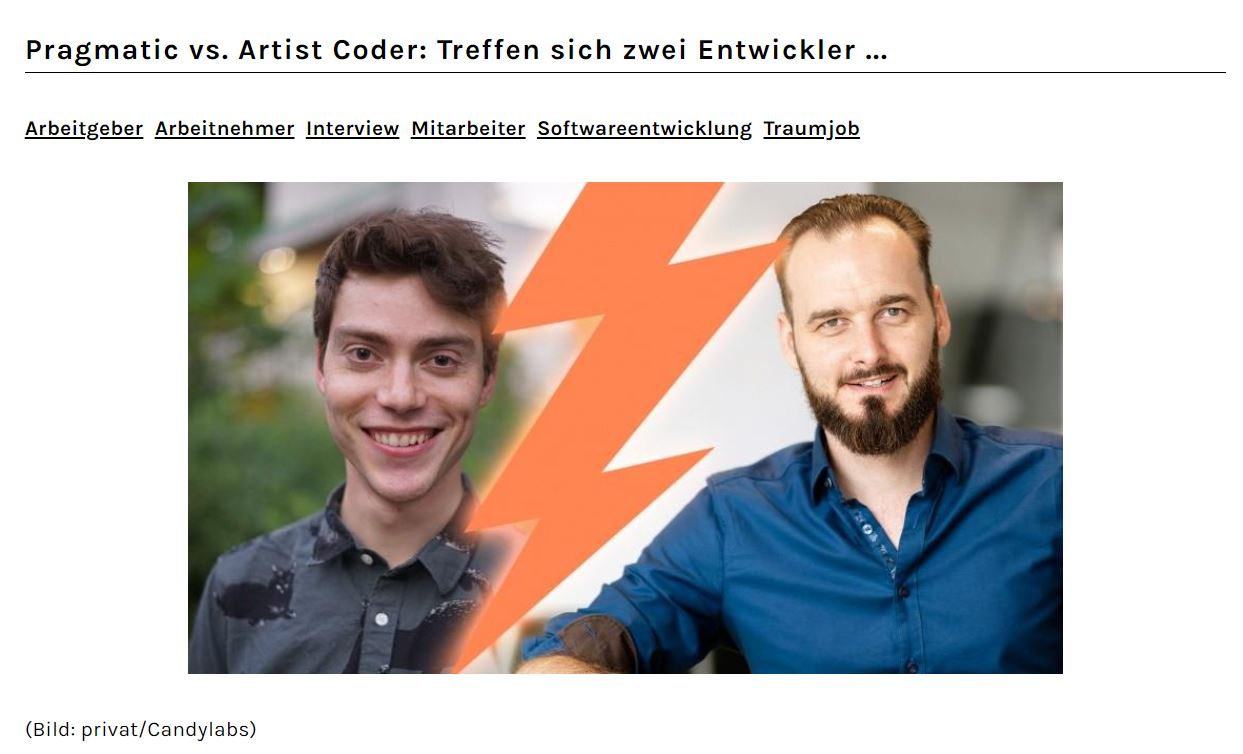
Alexander Dubovoy (li.) und Dominik Seemann von Candylabs im Gespräch mit Maja Hoock von golem.de
Programmierer Alexander Dubovoy (li.) und Dominik Seemann von Candylabs im Gespräch mit Maja Hoock von golem.de

Auch unter Entwicklern gibt es Künstler und Pragmatiker. In Firmen führt das öfter zu Konflikten. Aber dass diese Programmierertypen auch viel gemeinsam haben, stellten zwei typische Vertreter in diesem Golem.de-Gespräch fest.

Arbeiten Entwickler mit unterschiedlichen Vorstellungen vom Programmieren in einem Team, geraten Projekte schon mal ins Stocken. Etwa wenn die einen Code als Kunstwerke betrachten und deswegen anders ans Entwickeln herangehen als Pragmatiker, die alles möglichst effizient erledigen wollen. Ein golem.de Artikel von Maja Hoock.

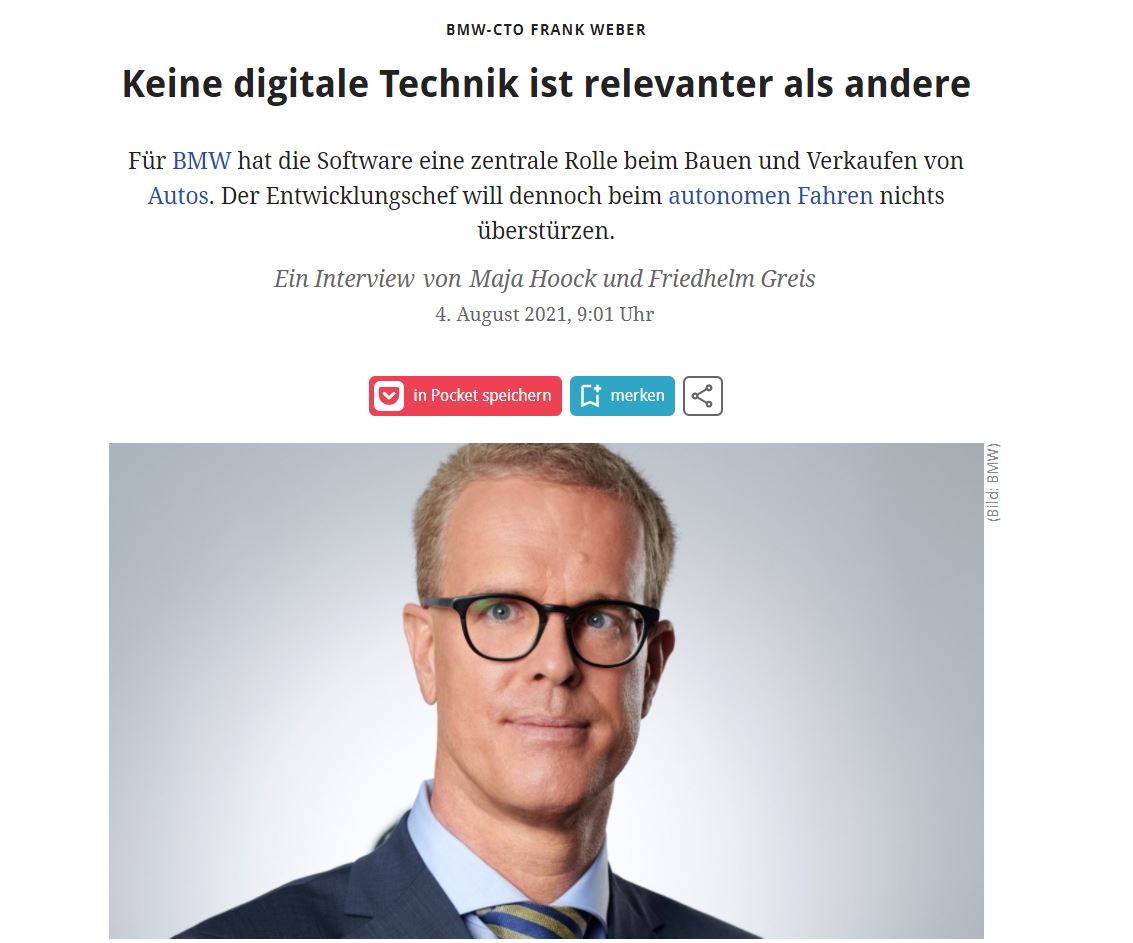
Interview mit Maja Hoock und BMW CTO Frank Weber für golem.de

Seit Juli 2020 ist Frank Weber CTO beim Münchner Autohersteller BMW. Golem.de hat mit dem Entwicklungschef über neue Herausforderungen für Autokonzerne und die wichtigsten Entwicklungen im Autobau gesprochen.

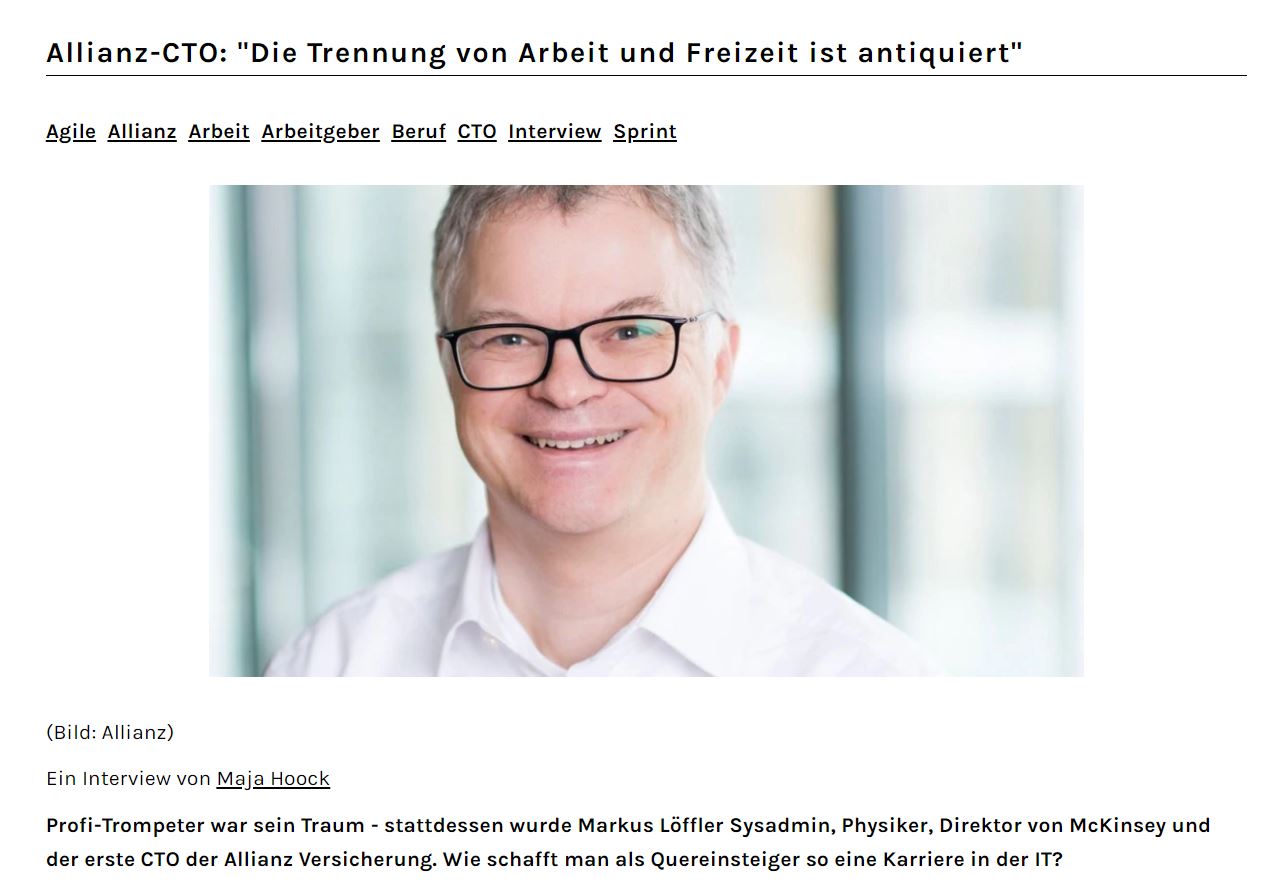
Allianz CTO Markus Löffler im Interview mit Maja Hoock (Golem)

In einer Interview-Reihe befragen wir Technikchefs zu ihrer Arbeit, ihren Einstellungskriterien und Trends. Zum Schluss gibt es noch ein Ein-Antwort-Spiel. Lasst uns im Forum wissen, welche Kandidaten und Fragen ihr euch zusätzlich fürs nächste Interview wünscht. Alle CTO-Interviews der Reihe sind hier zu finden.

Siemens CTO Peter Körte im Interview mit Maja Hoock und golem.de

Siemens CTO Peter Körte im Interview mit Maja Hoock und golem.de

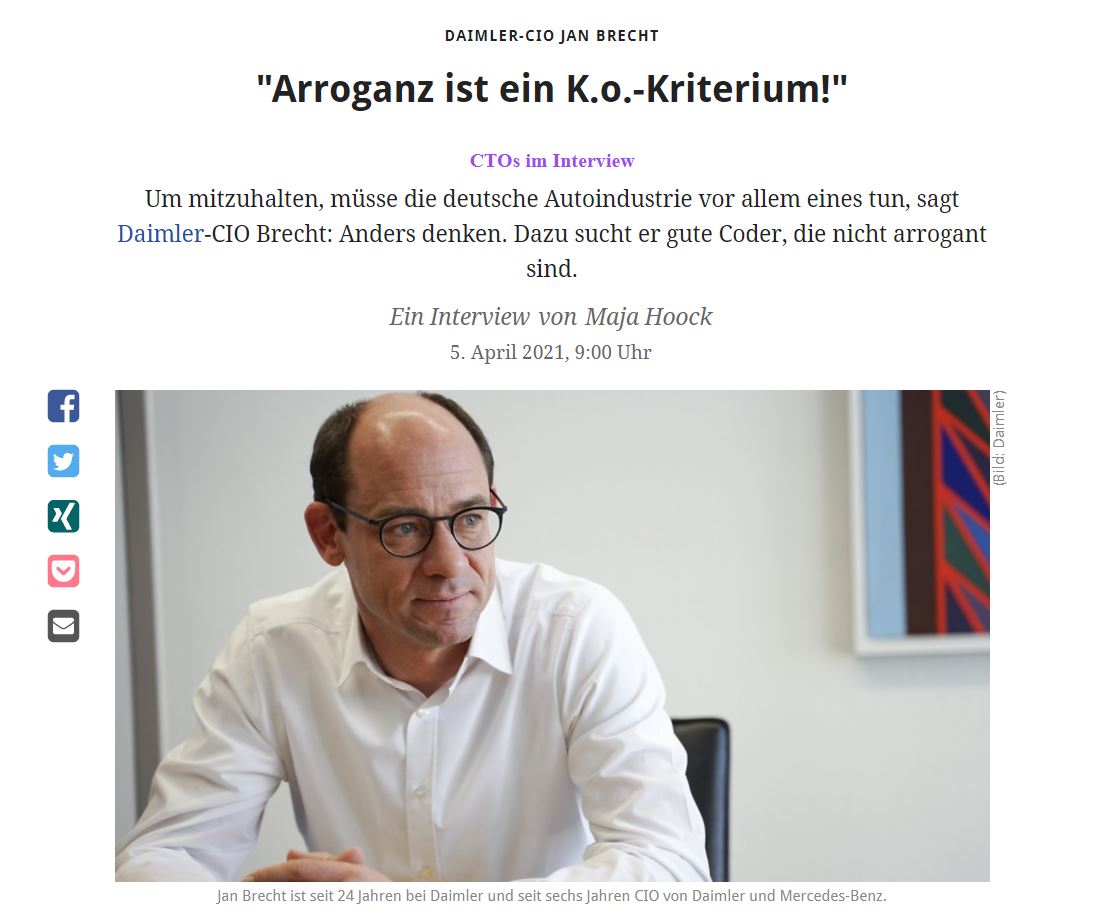
Daimler will mit Mercedes-Benz perspektivisch weg vom Verbrenner, zeitgemäßer werden und damit gewissermaßen Tesla einholen. Dafür gibt es ein strammes Programm, das unter anderem CIO Jan Brecht umsetzt.

Daimler will mit Mercedes-Benz perspektivisch weg vom Verbrenner, zeitgemäßer werden und damit gewissermaßen Tesla einholen. Dafür gibt es ein strammes Programm, das unter anderem CIO Jan Brecht umsetzt. Golem-Interview von Maja Hoock

Auto1 CTO Kevin Graham

Als der Online-Gebrauchtwagenhändler Auto1 im Februar an der Börse debütierte, war das wertvollste deutsche Startup plötzlich zehn Milliarden Euro wert. Bekannt wurde es durch den Ankauf von Privatfahrzeugen und die Weitervermittlung an Händler. Interview von Maja Hoock

Fumiko Inakuma vermisst ihr Großraumbüro mit den ständig klingelnden Telefonen überhaupt nicht. Auch nicht, von Bahnmitarbeitern mit weißen Handschuhen in die Tokioter U-Bahn geschoben zu werden, um dann zwei Stunden dicht an dicht mit anderen Pendlern durch die Stadt zu fahren. In der Arbeit sei sie oft sehr müde gewesen, besonders nachmittags, sagt sie.

Fumiko Inakuma vermisst ihr Großraumbüro mit den ständig klingelnden Telefonen überhaupt nicht. Auch nicht, von Bahnmitarbeitern mit weißen Handschuhen in die Tokioter U-Bahn geschoben zu werden, um dann zwei Stunden dicht an dicht mit anderen Pendlern durch die Stadt zu fahren. In der Arbeit sei sie oft sehr müde gewesen, besonders nachmittags, sagt sie. Interview von Maja Hoock

Ertan Özdil ist Gründer und CTO der cloudbasierten Enterprise Ressource Planning (ERP)-Plattform Weclapp.
Ertan Özdil ist Gründer und CTO der cloudbasierten Enterprise Ressource Planning (ERP)-Plattform Weclapp. Interview von Maja Hoock

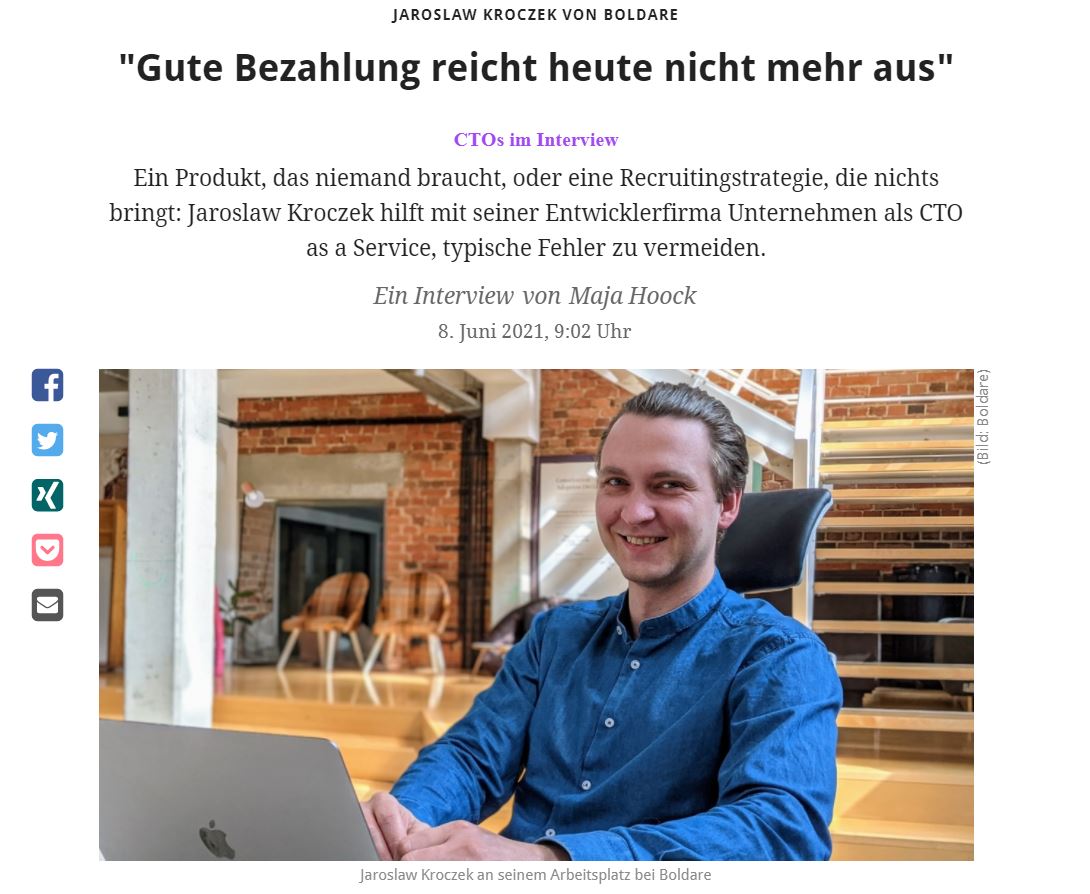
Ein häufiger Grund für gescheiterte Software-Projekte ist laut Studien, dass Kunden ein Produkt in Auftrag geben, das niemand braucht. Jaroslaw Kroczek und sein Team wollen solche Fehlschläge vermeiden und treten deswegen nicht nur als reine Entwickler auf, sondern auch als "CTO as a Service".

Ein häufiger Grund für gescheiterte Software-Projekte ist laut Studien, dass Kunden ein Produkt in Auftrag geben, das niemand braucht. Jaroslaw Kroczek und sein Team wollen solche Fehlschläge vermeiden und treten deswegen nicht nur als reine Entwickler auf, sondern auch als „CTO as a Service“. Interview von Maja Hoock

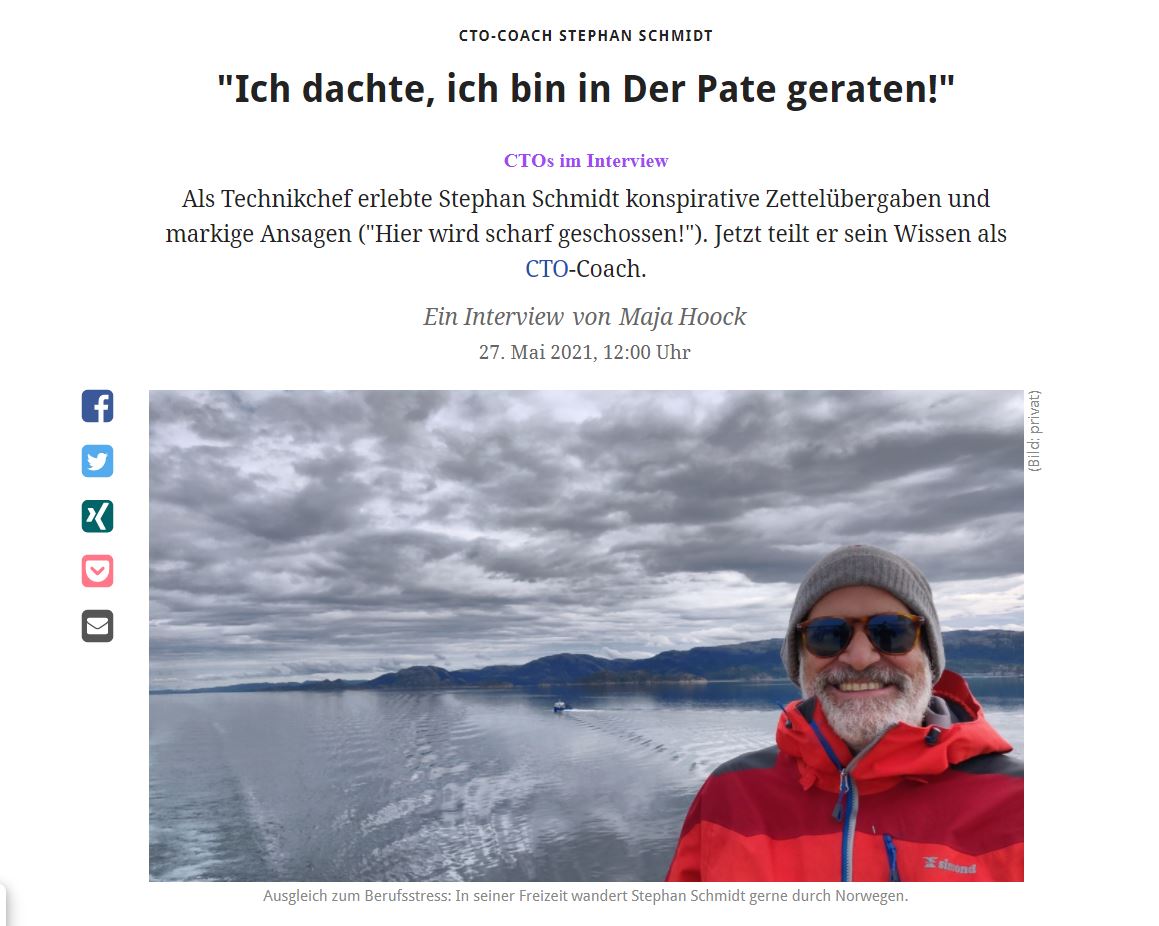
Stephan Schmidt hat ein Diplom in Informatik und eine Ausbildung zum Scrum-Master, aber er hat auch Philosophie studiert. Als CTO-Coach unterstützt er heute Chief Technology Officers (CTOs) verschiedener Unternehmen. Unter anderem versucht er, Strukturen in fremden Tech-Teams zu erkennen und ihnen einen Leitfaden an die Hand zu geben, um ihre Ziele besser zu erreichen.

Stephan Schmidt hat ein Diplom in Informatik und eine Ausbildung zum Scrum-Master, aber er hat auch Philosophie studiert. Als CTO-Coach unterstützt er heute Chief Technology Officers (CTOs) verschiedener Unternehmen. Unter anderem versucht er, Strukturen in fremden Tech-Teams zu erkennen und ihnen einen Leitfaden an die Hand zu geben, um ihre Ziele besser zu erreichen. Golem-Interview von Maja Hoock

Code kann eine künstlerische Handschrift bekommen - vorausgesetzt die Verfasser verstehen ihr Handwerk so gut, dass es nicht mehr nur ums Funktionieren geht, sondern auch um die Ästhetik. "Wissenschaft ist das, was wir gut genug verstehen, um es einem Computer zu erklären", sagte der US-amerikanische Informatikpionier Donald E. Knuth dazu einmal in einem Interview mit Jack Woehr. "Alles andere ist Kunst."

Code kann eine künstlerische Handschrift bekommen – vorausgesetzt die Verfasser verstehen ihr Handwerk so gut, dass es nicht mehr nur ums Funktionieren geht, sondern auch um die Ästhetik. „Wissenschaft ist das, was wir gut genug verstehen, um es einem Computer zu erklären“, sagte der US-amerikanische Informatikpionier Donald E. Knuth dazu einmal in einem Interview mit Jack Woehr. „Alles andere ist Kunst.“ Golem-Artikel von Maja Hoock

Auch als Podcast zum Anhören.

Golem-Artikel von Maja Hoock

Diesen Artikel gibt es auch als Podcast zum Anhören per Spotify & Co.

Eine der wenigen urbanen Ecken in Wien: Daniel Schatzmayr, lange braune Haare, schwarzes Hackerspace-Shirt, sitzt an seinem Rechner im Bürokomplex von Ottobock mit Blick auf eine große Hochstraße. Um ihn herum sind künstliche Gelenke, Knie und Unterschenkel aufgebaut. Ein einzelner Fuß steht neben einem Ficus Benjamini.

Eine der wenigen urbanen Ecken in Wien: Daniel Schatzmayr, lange braune Haare, schwarzes Hackerspace-Shirt, sitzt an seinem Rechner im Bürokomplex von Ottobock mit Blick auf eine große Hochstraße. Um ihn herum sind künstliche Gelenke, Knie und Unterschenkel aufgebaut. Ein einzelner Fuß steht neben einem Ficus Benjamini. Golem-Artikel von Maja Hoock

Golem-Artikel von Maja Hoock. Auch zum Anhören als Podcast!

Golem-Artikel von Maja Hoock.

Den Artikel hier auch online lesen oder hier als Podcast anhören!

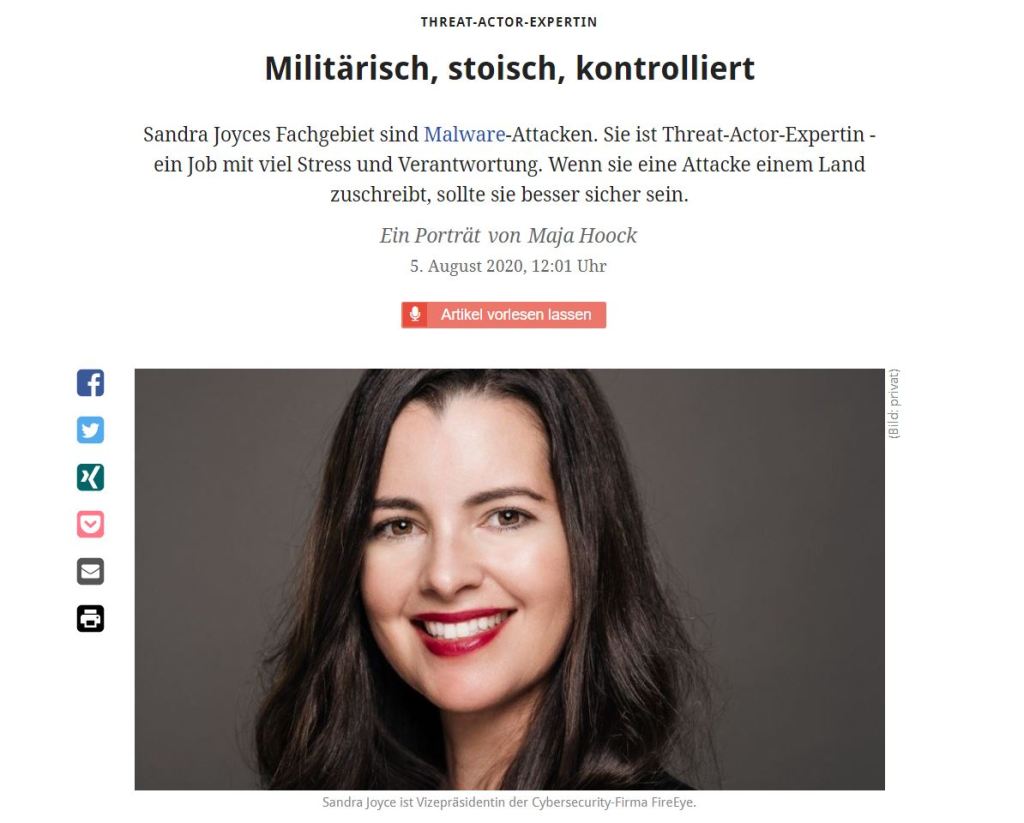
Sandra Joyce sitzt im Homeoffice im Horse Country im US-Bundesstaat Virginia. Entfernt bellt ihr Hund, die fünf Kinder sind zu Hause. Corona hat ihre tägliche Pendelstrecke stark reduziert und obwohl die Szenerie idyllischer ist als im verspiegelten Glasbau von Mandiant Threat Intelligence, bleibt ihre Arbeit nervenaufreibend. Die 42-Jährige führt als Vice President der Cybersecurityfirma Untersuchungen an, die eine gewisse Schnittmenge mit Geheimdienstaktivitäten haben. Golem-Artikel von Maja Hoock.

Den Artikel kann man auch hier als Podcast anhören!

Golem-Artikel von Maja Hoock. Den Artikel kann man auch hier als Podcast anhören!

Golem-Artikel von Maja Hoock. Den Artikel kann man auch hier als Podcast anhören!

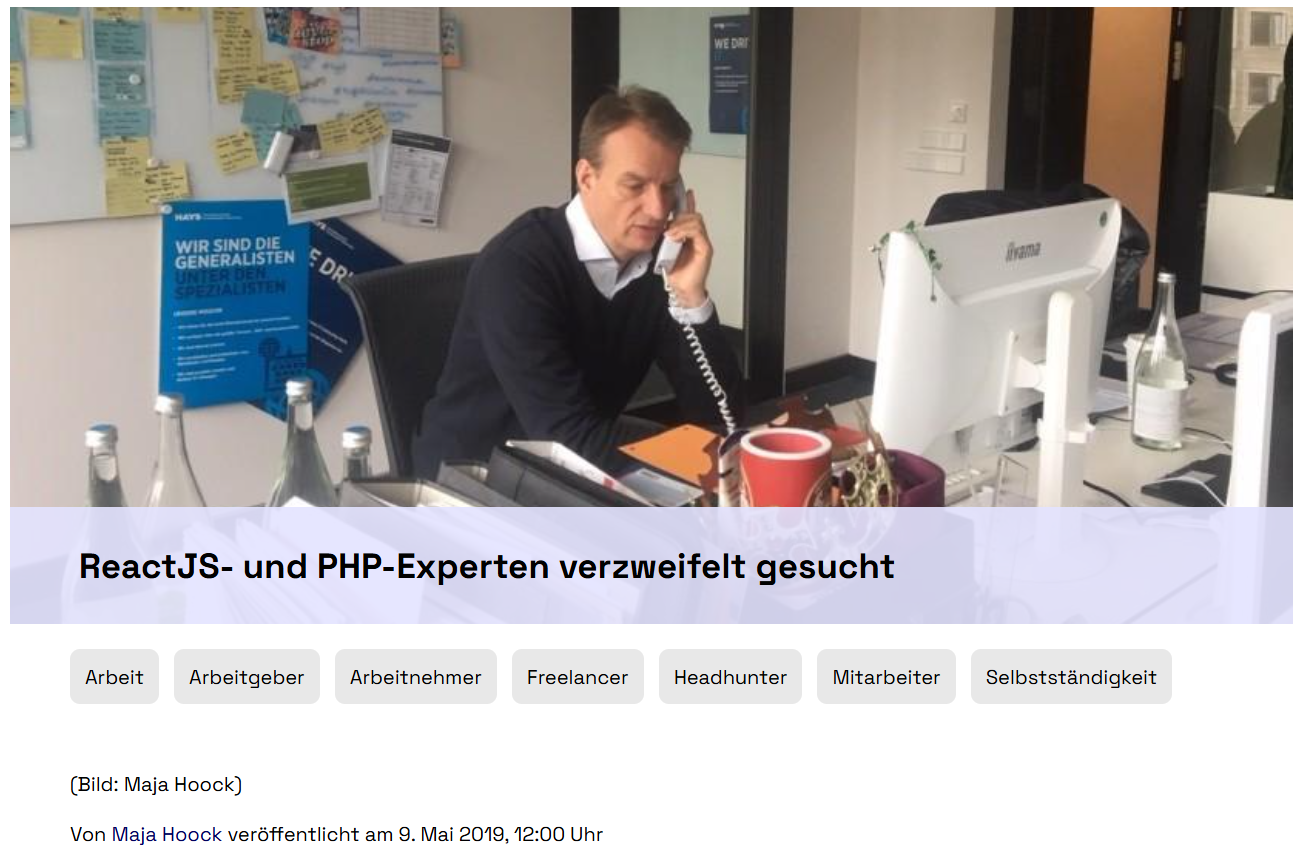
Marco Nadol vermittelt für Hays selbstständige Informatiker, Programmierer und Ingenieure in Unternehmen. Aus langjähriger Erfahrung als IT-Headhunter weiß er mittlerweile sehr gut, was ihre Chancen auf dem Markt erhöht und was sie verschlechtert.

Fußball und Arbeiten sind ein bisschen verwandt, findet Marco Nadol. Der 51-jährige IT-Headhunter verbringt seine Freizeit gerne auf dem Bolzplatz. „Wer gut in Mannschaftssport ist, kann wahrscheinlich auch Teamwork“, sagt er. Das gelte für ihn als Recruiter genauso wie für die Freelancer, die er vermittelt. Darum fragt er sie auch nach ihren Hobbys. Nach zwölf Jahren als Personalvermittler hat er seine Tricks um einzuschätzen, ob Charaktere in IT-Projekte passen oder nicht.

Mittlerweile braucht der Leiter der Berliner Niederlassung von Hays nach eigener Aussage nur noch 30 Sekunden dafür. „Es kommt darauf an, wie sie reagieren und mit mir sprechen“, sagt er. „Wenn ein agiles Startup sucht, das sich jeden Morgen zum Sprinten trifft, und man einem Kandidaten jedes Wort aus der Nase ziehen muss, passt das nicht. Wenn aber jemand in einem Konzern länger an einer Aufgabe eingesetzt werden soll, kann das funktionieren.“

Grünes Massaker

Gut: der Moment, wenn man die eisglatte Oberfläche eines Dr. Oetker Waldmeister-Wackelpuddings mit der beigefügten Vanillesoße benetzt, sie sich gleichmäßig fließend wie eine Welle am Strand ausbreitet, und dann mit dem ersten Stoß des Löffels in den eben entstandenen Graben mit den scharfen, aber trotzdem weich wabbelnden Kanten strömt. Weniger gut, aber trotzdem nicht zu verachten: der piksende Geschmack.